Madonna of the Letter
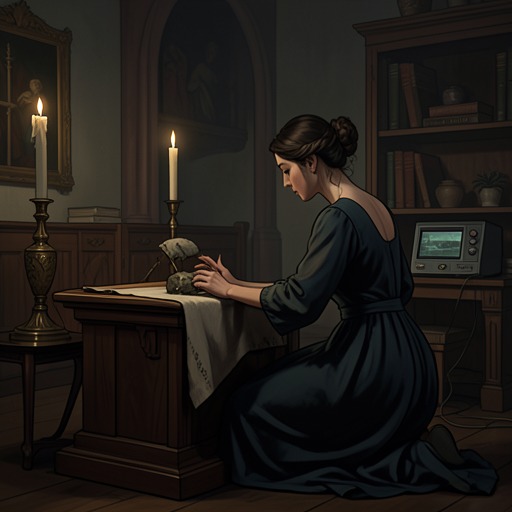
The LeopardThe Madonna of the Letter is a painting venerated by the Salina sisters in their family chapel. Its image of a young woman holding a crumpled letter supports a specifically Marian interpretation for the sisters, although the picture lacks the familiar symbols by which Mary is conventionally identified. When church authorities inspect the chapel, the painting becomes more than an object of household devotion: it is also a point at which artistic judgment, local belief, family prestige, and institutional authority meet.
Image and interpretation
The painting is described as being in the style of Cremona. It shows a slim young woman with abundant brown hair, her eyes turned upward and a letter gripped in her right hand. A gentle Lombard landscape appears behind her. The image includes none of the customary Marian signs noted by the narrative—no Holy Child, crown, snakes, or stars—so its identification depends instead on the woman’s expression and the story attached to the letter. The picture offers an image to interpret, rather than an unmistakable set of religious attributes.
That interpretation is supplied by the Salina women. Caterina calls the painting a miraculous icon, and Carolina identifies it as the Madonna of the Letter: the Virgin, she explains, is about to deliver a sacred message asking her Divine Son to protect the people of Messina. Carolina connects that protection to the many miracles said to have occurred during the earthquake two years earlier. The sisters’ account makes the letter central to the image’s meaning, turning a painted object into the visible focus of a local devotional claim.
The family chapel and its custodians
The chapel was established after the death of Don Fabrizio Corbera, Prince of Salina. In his lifetime, the family attended church on feast days, and Father Pirrone had to travel to say Mass. After inheritance complications left the Villa Salina exclusively to the three sisters, they converted an out-of-the-way drawing-room into an oratory, altering its decoration and preparing an altar. The painting became the most conspicuous focus of their private religious space.
The sisters’ devotion is expressed through both ritual and possession. When the Vicar-General approaches the picture, he examines it as an artwork, while the sisters behind him make the sign of the Cross and murmur an Ave Maria. The difference is small in gesture but important in perspective: the same painting is, for the visitor, a work to assess, and for the women, an image before which they pray. The chapel’s seclusion also matters. The family’s services were described as proper and continuous, but the Salina women were strongly reluctant to admit anyone outside their close circle to them.
Inspection and contested authority
The Cardinal Archbishop had begun inspecting private chapels in his diocese under Papal instructions, considering the qualifications of those permitted to hold services, the conformity of liturgy and decoration, and the authenticity of relics. The Salina chapel was among the first proposed for a visit. Rumours had reached the archiepiscopal Curia about the chapel’s celebrated picture and its large collection of relics, making the planned inspection a test of the family’s religious standing as well as of the objects themselves.
The Vicar-General’s response to the painting is measured. After looking at it, he praises its expressiveness and beauty, but does not affirm Carolina’s claim about its miracles. The distinction leaves the sisters’ account intact as their belief while withholding institutional confirmation. At the Cardinal’s visit the following day, he makes a hurried inspection and recommends that a Madonna of Pompeii take the place above the altar, with the existing picture joining the artworks he has admired in the rooms. He also suspends services in the chapel for three or four days pending its reconsecration. His decision changes the image’s position within the chapel without declaring that its claimed miracles have been disproved.
Significance and unresolved outcome
The painting’s role is shaped by the gap between devotional meaning and official recognition. For the sisters, its letter links the Virgin’s intercession to the protection of Messina; for the visiting clerics, it is subject to inspection and possible removal from the altar. The encounter does not resolve the truth of the miracle story. Instead, it shows how a private image can acquire public consequences when church authority examines the practices and objects through which a family expresses its faith.
The recommendation to replace the picture gives the inspection a concrete result, but the account does not say what ultimately happens to it. The Cardinal proposes that it be treated as a fine work of art rather than remain above the altar, preserving its value while changing its religious placement. That unresolved shift—from venerated icon to admired artwork—is the painting’s decisive significance in the episode: its appearance remains the same, while the authority to define what it means moves beyond the household.